Televisi LED COB All-in-One
  Tampilan LED Fleksibel
  Tampilan LED Transparan
  Poster yang Dipimpin
  Layar LED Melingkar
  Layar LED Kreatif & Kustom
 When your event production demands fast load-in, flawless on-camera performance, and panels that survive back-to-back shows — you need LED engineered for staging, not signage. This guide walks through the three problems standard suppliers don’t solve, the products engineered for live production, and the real-world data from production companies running 30+ festival dates per season.

- Setup speed is the real constraint on show day. Quick-lock connectors and tool-free assembly are not features — they are the difference between a clean soundcheck and a delayed curtain. A single crew member should assemble 50sqm in under two hours.
- Broadcast camera performance demands 3,840Hz minimum refresh rate. At 1,920Hz you will see visible scan lines on IMAG and broadcast feeds. All DOIT VISION rental panels operate at 3,840Hz as standard, verified against 4K broadcast cameras during factory calibration.
- One product family should cover indoor theatre (800 nits) to outdoor festival main stage (6,500 nits). Buying separate indoor and outdoor inventory doubles capital outlay. Matrix 500 is engineered so the same structural platform spans the full brightness range.
Kecepatan Penyiapan: Mengapa Ini Menjadi Kendala Utama di Hari Pameran
Concert production teams have hours, not days. A setup window of 8 hours from truck unload to show-ready is standard — and within that window, LED panel assembly competes with lighting rigging, audio tuning, and stage management for crew time.
Three factors determine how fast a crew can build an event LED wall:
1. Panel-to-panel connection mechanism
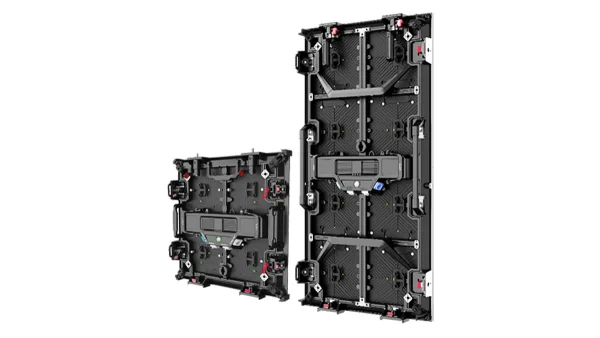
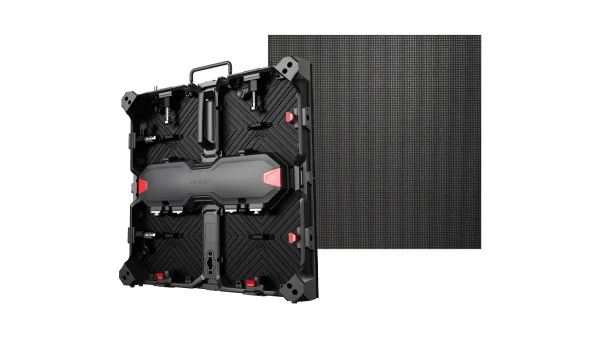
Products that integrate mechanical latching, signal connection, and power connection into a single two-step operation are significantly faster than designs requiring three separate steps. Matrix 500 quick-lock cabinets lock together without tools — a single crew member can close a cabinet joint in seconds, not minutes.
2. Flight case optimisation
Panel count per flight case determines load-in flow. Six panels per case, single-person lift weight (~22kg loaded), and stacking interlocks mean predictable handling regardless of crew size. Cases custom-matched to cabinet dimensions eliminate wasted truck space and protect panels during city-to-city moves.
3. Post-assembly calibration requirement
The single biggest hidden time cost in event LED deployment is on-site controller mapping — assigning each receiving card’s physical position in the cabinet grid. This takes 3–4 hours when done from scratch on every setup. Pre-configured cabinet map files eliminate this step entirely. The controller recognises every receiving card instantly. The wall is live within 15 minutes of completing physical assembly.
An experienced two-person crew should assemble approximately 50sqm of rental LED in two hours with an optimised product. If a product cannot approach this rate, it will create setup window problems on show day — every show day.

Camera Performance: Why 3,840Hz Is the Minimum for Broadcast and IMAG
On a stage with IMAG cameras, a 1,920Hz panel will show scan lines on the broadcast feed. This is not a subtle artefact — it is visible to millions of viewers. For live production companies running camera-facing LED walls, refresh rate is a non-negotiable specification.
Visible scan lines on broadcast and IMAG cameras at standard shutter speeds. Usable for audience-facing content only. Not suitable for any camera-facing application.
Clean capture with broadcast cameras at standard shutter speeds. High-speed camera pans are clean. Verified against 4K broadcast cameras during factory calibration. The minimum for professional event production.
All DOIT VISION rental panels — Matrix 500, X-1000, Lite Series, and Flex Series — operate at 3,840Hz as standard. This is not an optional upgrade; it is the baseline specification. Annual calibration verification is included in our standard post-delivery support.
Redundancy: A single failure cannot break the show
Matrix 500 supports dual-power and dual-signal backup with automatic failover. If the primary controller fails mid-show, the backup takes over within one frame — the audience sees nothing. Pre-configured controller map files shipped with every order mean the crew does not troubleshoot receiving card mapping in the dark at 2 AM.
We recommend 2–3% spare module inventory by count. Front-service magnetic mounting means one person swaps a dead module in under three minutes without dismounting the wall — critical when the opening act is already onstage. Spare modules available for single-item reorder within 10–15 days, same part number, 10+ year SKU continuity.
Indoor Theatre to Outdoor Festival: One System Covers It All
A production company running 40+ shows per season across different venue types should not need separate indoor and outdoor LED inventory. That doubles capital outlay, complicates logistics, and duplicates spare parts management.
Matrix 500 is engineered so the same structural platform runs indoor at 800 nits and outdoor at 6,500 nits. Specify the IP65 outdoor version and run it at reduced brightness for indoor shows — same modules, same flight cases, same reorder process.
| Jenis acara | Produk yang Direkomendasikan | Nada | Kecerahan |
|---|---|---|---|
| Indoor Concert / Theatre | Matrix 500 P2.6 | P1.9 – P2.6 | 800–1,200 nits |
| Corporate Event / Keynote | Matrix 500 P2.6 | P2.6 – P3.0 | nits 1,200 |
| Tenda/Area Luar Ruangan Tertutup | X-1000 P3.0 | P3.0 | 2,500–3,500 nits |
| Outdoor Festival Main Stage | X-1000 P3.9 | P3.9 | 5,000–6,500 nits |
If your inventory moves between indoor and outdoor venues, specify the IP65 outdoor version and run it at reduced brightness indoors. Matrix 500 P3.9 Outdoor at 6,500 nits can run at 30–50% brightness for indoor shows — one product, every venue type, zero duplication of capital outlay.
Controller Pre-Configuration: Plug In and Go
Rental panels ship pre-configured for the controller you specify — Novastar or Colorlight across the rental range; Brompton Tessera on Matrix 500 as a separate receiving-card configuration. Cabinet map files, receiving card layouts, and a config USB are included in every crate. No on-site controller mapping required.
The full shipment for a typical fleet order includes: panels with quick-lock connectors, custom-matched flight cases, hanging beams, power/signal connectors (Neutrik etherCON and PowerCON), dual-controller system with automatic failover, spare modules (calculated per screen area), calibration report, and remote commissioning support during load-in.
What “Pre-Configured” Actually Means
- Each receiving card is flashed with its physical position in the cabinet grid (row × column).
- The cabinet map file (.rcfg for Novastar,.tsm for Brompton) is saved to a USB drive labelled with the screen configuration.
- The entire wall is assembled at the factory in the exact configuration it will be deployed — every cabinet, every cable, every signal path verified end-to-end.
- A backup copy of the map file is emailed to the rental company’s technical contact before the crate ships.
A production company doing 30 setups per season saves approximately 90–120 crew-hours per year by eliminating on-site controller mapping. At an average crew rate, that is a recurring saving that exceeds the controller hardware cost within the first year of operation.
Which Panel Fits Your Production Style?
Three rental LED series cover the event production spectrum. Here is how to choose:
- P1.9–P3.9, IP65 outdoor option up to 6,500 nits
- Lightweight 250×250mm module system, front-service
- Quick-lock connectors, tool-free assembly
- Novastar / Colorlight standard; Brompton Tessera version quoted separately by receiving-card config
- Best for: city-to-city touring, small crew, 40+ shows/year
- P2.9–P3.9, IP65 outdoor up to 6,500 nits
- Large cabinet — fewer joints, faster large builds
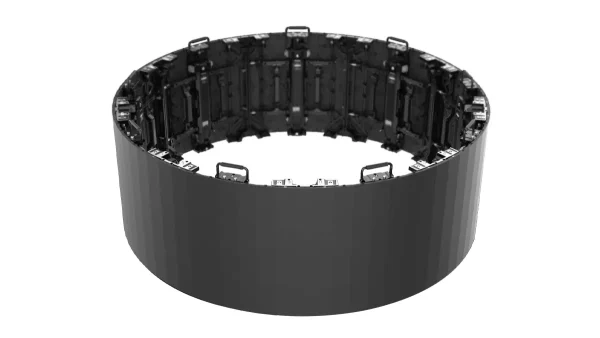
- Right-angle and curved configurations available
- Novastar saja
- Best for: arena main stage, festival, equipped crews
- P2.6–P3.9, indoor IP40
- Opsi kabinet 500×500mm dan 500×1000mm
- Rakitan melengkung opsional
- Novastar / Colorlight
- Best for: conference, church, first rental inventory build
| Spesifikasi | Matriks 500 | X-1000 | Lite |
|---|---|---|---|
| Pixel pitch | P1.9 – P3.9 | P2.9 / P3.9 | P2.6 / P3.9 |
| Kecerahan Puncak | Hingga 6,500 nit | Hingga 6,500 nit | Hingga 1,200 nit |
| IP Penilaian | IP65 luar ruangan | IP65 luar ruangan | IP40 indoor |
| Refresh Rate | 3,840Hz | 3,840Hz | 3,840Hz |
| Cadangan Ganda | Power & signal | Power & signal | Cadangan daya |
| terbaik Untuk | Tur keliling, sering berpindah tempat | Arena, panggung utama festival | First inventory, budget build |
For the full product comparison including Flex Series and detailed specifications, see the pusat produk layar LED sewaan.
Real-World Production Data: What Four Years Look Like
Production companies want to know what happens after year one — not just the demo experience. Here is data from two rental companies running DOIT VISION panels across European and US festival circuits.
Matrix 500 P3.9, 150sqm touring configuration. Novastar A8s pre-configured. Four years of weekly deployment cycles across 12 European countries. Zero cabinet flatness failures. Spare module reorders at same part number. Client reports 90-minute average build time for the full 150sqm wall with a four-person crew.
X-1000 P3.9, 65sqm outdoor main stage. Replaced a 3,500-nit product that was borderline unusable in direct afternoon sunlight. At 6,500 nits, content fully readable in direct sun — a condition the previous product could not meet. IP65 rated through multiple rain delays. Large cabinet format reduced assembly time versus previous standard-cabinet product.
- Controller pre-configuration eliminated on-site mapping across every deployment
- Flight cases custom-matched to cabinet dimensions meant predictable truck-pack and load-in flow
- 2–3% spare module inventory covered all operational failures across four years — zero show-cancelling incidents from module failure
- Same part number spare module reorder preserved screen uniformity across seasons
Read the full case studies: German Touring — Matrix 500 4-Year Report ke US Festival — X-1000 IP65 Verification.
Send your typical event types, screen sizes, and budget range. An engineer recommends the right product and provides a line-by-line quote with accessory breakdown within 24 hours.